

Achilles tendinitis can make every step feel frustrating.
You may feel pain above your heel when you walk. You may wake up with stiffness in the back of your ankle. Running may hurt. Stairs may feel uncomfortable. Even standing on your toes can become difficult.
So the question is simple, can a chiropractor help Achilles tendinitis?
In many cases, yes. A chiropractor may help Achilles tendinitis by evaluating how your foot, ankle, calf, knee, hip, and lower back work together. Treatment may include soft tissue therapy, joint mobility work, corrective exercises, stretching guidance, gait evaluation, and activity modification. The goal is not just to reduce pain around the Achilles tendon, but to understand why the tendon is being overloaded in the first place.
At Maverick Chiropractic, our chiropractors offer Achilles Tendinitis treatment in Naperville by helping them look beyond the sore spot. We focus on how your lower body moves as a whole, so we can identify the mobility restrictions, muscle imbalances, and movement patterns that may be placing extra stress on the Achilles tendon.
That said, Achilles tendinitis is not something to ignore or push through. The right care depends on the severity, location, and cause of your pain.
Let’s break it down.
What Is Achilles Tendinitis?
Achilles tendinitis is irritation of the Achilles tendon, the strong band of tissue that connects your calf muscles to your heel bone. This tendon helps you walk, run, jump, climb stairs, and push up onto your toes.
AAOS describes Achilles tendinitis as a common condition that causes pain along the back of the leg near the heel. The Achilles tendon is the largest tendon in the body and is used when walking, running, climbing stairs, jumping, and standing on tiptoes.
Achilles tendinitis is often caused by overuse. Mayo Clinic notes that it commonly happens in runners who suddenly increase how hard or long they run, and it can also affect middle-aged people who play sports occasionally.
You may also hear it called:
- Achilles tendonitis
- Achilles tendinopathy
- Achilles tendon pain
- Insertional Achilles tendinitis
- Midportion Achilles tendinopathy
Many people use “tendinitis” and “tendonitis” interchangeably. Clinically, longer-lasting tendon pain is sometimes called tendinopathy because chronic tendon problems are not always just inflammation.
Common Symptoms of Achilles Tendinitis
Achilles tendinitis often starts slowly. At first, it may feel like mild soreness. Then it can become more painful with walking, running, stairs, or exercise. Common symptoms include:
- Pain above the heel
- Pain along the back of the ankle
- Morning stiffness
- Tenderness in the Achilles tendon
- Pain that worsens with activity
- Swelling near the tendon
- Tightness in the calf
- Pain when walking uphill or climbing stairs
- Pain after running or jumping
- Discomfort when standing on your toes
AAOS lists common symptoms such as pain and stiffness along the Achilles tendon in the morning, pain that worsens with activity, severe pain the day after exercising, tendon thickening, swelling, and pain on the back of the heel when wearing shoes.
If you feel a sudden pop in the back of your calf or heel, that may be a sign of an Achilles tendon rupture. That needs urgent medical evaluation.
Why Does Achilles Tendinitis Happen?
Achilles tendinitis usually happens when the tendon is asked to handle more load than it is ready for.
That can happen because of:
- Sudden increase in running mileage
- Sprinting or hill workouts
- Jumping sports
- Tight calf muscles
- Poor ankle mobility
- Unsupportive shoes
- Flat feet or high arches
- Training on hard surfaces
- Weak calf muscles
- Poor running mechanics
- Not enough recovery
- Weekend sports after sitting all week
- Previous ankle or foot injuries
Mayo Clinic Health System explains that Achilles tendinitis commonly occurs when people suddenly increase the intensity or duration of exercise or have not been properly trained for their sport.
For many patients, Achilles pain is not only a tendon issue. It is a load management issue. The tendon is being stressed repeatedly, and the surrounding areas may not be doing their job well enough to share that stress.
That is where chiropractic evaluation may help.
How Can a Chiropractor Help Achilles Tendinitis?
A chiropractor can help by looking at the full movement chain, not just the painful tendon.
The Achilles tendon is connected to the calf, but your calf is influenced by your ankle, foot, knee, hip, pelvis, and lower back. If one area is stiff, weak, unstable, or moving poorly, the Achilles tendon may absorb more stress.
A chiropractor may evaluate:
- Ankle mobility
- Foot mechanics
- Calf tightness
- Achilles tendon tenderness
- Walking or running mechanics
- Knee and hip movement
- Balance and stability
- Lower back and pelvic mechanics
- Shoe wear patterns
- Training habits
- Work activity
- Pain triggers
The goal is to find out why the Achilles tendon is irritated and what needs to change so it can heal.
Chiropractic Treatment Options for Achilles Tendinitis
Chiropractic care for Achilles tendinitis may include several conservative strategies.
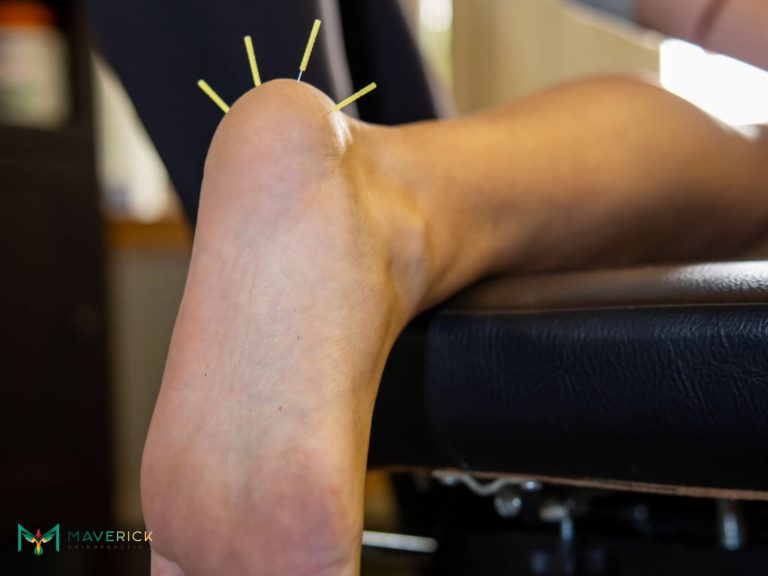
Soft Tissue Therapy
Soft tissue therapy may be used to address tension, restriction, or irritation in the calf muscles, Achilles tendon area, and surrounding tissues.
This may include hands-on muscle work, instrument-assisted soft tissue work, or other techniques depending on the clinic and the patient’s condition.
A randomized controlled trial on insertional Achilles tendinopathy found that soft tissue treatment combined with eccentric exercise resulted in greater improvements than eccentric exercise alone in that study group.
That does not mean soft tissue therapy is a magic fix. It means that for some patients, combining tissue work with the right strengthening plan may be more helpful than exercise alone.
Ankle and Foot Mobility Work
If the ankle does not move well, the Achilles tendon can be forced to work harder during walking, running, squatting, or stairs. A chiropractor may work on improving mobility in the ankle, foot, and surrounding joints when restrictions are contributing to symptoms.
This can be especially helpful for people who feel:
- Stiffness when walking
- Limited ankle motion
- Tight calves
- Pain going upstairs
- Pain during squats or lunges
- Achilles pain after running
Lower-Body Alignment and Movement Assessment
Achilles pain can be affected by how the foot, knee, hip, and pelvis move together.
For example, if the foot collapses inward, the calf is weak, or the hip does not control the leg well, the Achilles tendon may experience extra strain.
A chiropractor may assess movement patterns like:
- Walking
- Squatting
- Heel raises
- Single-leg balance
- Step-downs
- Running mechanics when appropriate
This matters because pain relief without movement correction often leads to the same problem coming back.
Calf Strengthening and Eccentric Loading
Exercise is one of the most important parts of Achilles tendinitis recovery.
Many rehab programs focus on progressive calf strengthening and eccentric loading. Eccentric exercise means the muscle lengthens while it is under tension. For the Achilles, this often involves controlled heel-lowering exercises.
A chiropractor may prescribe or guide exercises such as:
- Double-leg heel raises
- Single-leg heel raises
- Seated calf raises
- Eccentric heel drops
- Isometric calf holds
- Balance exercises
- Foot and ankle strengthening
- Hip stability exercises
The important thing is progression. Doing too much too soon can make Achilles pain worse.
Stretching Guidance
Many people assume they should aggressively stretch Achilles pain. Sometimes gentle stretching helps. Other times, especially with insertional Achilles pain near the heel, aggressive stretching can increase irritation.
A chiropractor can help determine whether stretching is appropriate and how much is safe.
This is important because Achilles pain is not always solved by stretching. Sometimes the tendon needs better strength and load tolerance, not more pulling.
Activity Modification
Achilles tendinitis often gets worse when people keep doing the same activity that caused the irritation.
That may include:
- Running through pain
- Sprinting too soon
- Hill workouts
- Jumping workouts
- Long walks without rest
- Unsupportive shoes
- Sudden workout increases
Cleveland Clinic lists rest, physical therapy, and supportive shoes as common treatment options for Achilles tendinitis.
A chiropractor can help you modify activity without stopping everything unnecessarily. The goal is to keep you moving while reducing the load that keeps irritating the tendon.
Return-to-Activity Planning
One of the biggest mistakes people make with Achilles tendinitis is returning to running or sports as soon as the pain feels better.
Pain relief does not always mean the tendon is ready.
A good return plan should consider:
- Morning stiffness
- Pain during activity
- Pain the next day
- Calf strength
- Single-leg control
- Walking tolerance
- Running volume
- Speed work
- Hills
- Jumping and sport demands
This is where guided care can make a big difference.
Can Chiropractic Care Cure Achilles Tendinitis?
It is better to think of chiropractic care as part of a conservative treatment plan, not a “cure.”
Achilles tendinitis usually improves when the tendon is given the right mix of reduced irritation, progressive loading, soft tissue support, mobility work, and time. Chiropractic care may help identify and address the mechanical issues that contribute to tendon overload.
For many patients, this can mean less pain, better movement, stronger calves, improved walking or running mechanics, and a clearer plan for returning to activity.
But if there is a rupture, severe tear, infection, major swelling, or worsening symptoms, medical referral may be needed.
When Should You See a Chiropractor for Achilles Tendinitis?
You should consider seeing a chiropractor or another qualified provider if:
- Achilles pain has lasted more than 1 to 2 weeks
- Pain keeps returning after rest
- You have pain when walking
- Your Achilles hurts after running
- You have morning stiffness
- You feel calf tightness that will not improve
- Stairs make the pain worse
- You cannot stand on your toes comfortably
- You are changing how you walk because of pain
- You want non-surgical Achilles tendon pain treatment
- You are unsure if the pain is Achilles tendinitis, plantar fasciitis, or another issue
If you are looking for a chiropractor in Naperville for Achilles tendinitis treatment near you, the best next step is usually an evaluation. The sooner you understand what is driving the pain, the easier it is to avoid making the tendon worse.
Achilles Tendinitis vs Plantar Fasciitis
Achilles tendinitis and plantar fasciitis can both cause heel pain, but they usually hurt in different places.
Achilles tendinitis usually causes pain at the back of the heel or slightly above the heel along the tendon.
Plantar fasciitis usually causes pain under the heel or along the bottom of the foot.
Both can cause morning pain or stiffness, which is why people sometimes confuse them. A proper exam can help identify which structure is irritated and what type of treatment makes sense.
Can Achilles Tendinitis Heal Without Surgery?
Yes, many cases of Achilles tendinitis improve without surgery. Conservative care may include:
- Activity modification
- Supportive footwear
- Heel lifts when appropriate
- Soft tissue therapy
- Calf strengthening
- Eccentric loading
- Mobility work
- Physical therapy
- Chiropractic care
- Gradual return to running or sport
Surgery is usually reserved for cases that do not respond to conservative care or involve more serious structural problems.
What Should You Avoid With Achilles Tendinitis?
If your Achilles tendon is irritated, avoid repeatedly pushing into pain. You may need to temporarily reduce or modify:
- Running
- Sprinting
- Hill workouts
- Jumping
- Plyometrics
- Long walks
- Heavy calf raises
- Barefoot training
- Unsupportive shoes
- Aggressive calf stretching
- Sudden increases in exercise volume
You do not always need complete rest. In fact, too much rest can leave the tendon weaker. The key is finding the right level of activity that does not keep flaring the tendon.
At-Home Tips for Achilles Tendinitis
If symptoms are mild and there was no sudden injury, these steps may help:
- Reduce painful activity: Avoid the activities that make symptoms worse during and after movement.
- Wear supportive shoes: Supportive shoes can reduce strain on the tendon. Cleveland Clinic includes supportive shoes as part of common Achilles tendinitis treatment.
- Try gentle calf mobility: Avoid aggressive stretching if it increases pain, especially near the heel.
- Start with controlled strengthening: Simple heel raises may be helpful, but start carefully and progress gradually.
- Watch morning pain: Morning stiffness is a useful signal. If the tendon feels worse the morning after activity, you may have done too much.
- Do not run through sharp pain: Running through Achilles pain can turn a small irritation into a longer recovery.
Why Naperville Patients Should Not Ignore Achilles Tendon Pain
Naperville has a very active population. People run, walk, bike, play tennis, coach youth sports, work out, and stay busy with family life.
Achilles pain can sneak up slowly, but it can also start limiting everyday movement fast.
You may notice pain when:
- Walking around downtown Naperville
- Running local trails
- Climbing stairs at home
- Standing for work
- Walking the dog
- Playing recreational sports
- Working out at the gym
- Getting out of bed in the morning
The earlier Achilles tendinitis is addressed, the easier it usually is to manage. Waiting until the tendon becomes chronically irritated can make recovery longer.
Final Takeaway
For many people, a chiropractic care may help by addressing the movement problems, soft tissue tension, joint restrictions, calf weakness, ankle stiffness, and activity habits that contribute to Achilles tendon overload.
The key is not just treating the painful spot. The key is understanding why the tendon is irritated and building a plan that helps it tolerate daily activity again.
For people in Naperville dealing with Achilles pain when walking, running, climbing stairs, or getting out of bed, Maverick Chiropractic provides conservative care focused on movement, function, and long-term relief. Call us at 331-302-9039 to book an appointment today!